
Author: Godwin Samuel – Travel Publisher, Nigerian Traveler and Founder of GreenLink.com.ng
Category: Hotel Guides
Published Date: 23 October 2026
Last Updated: 23 October 2026
Introduction
Booking a hotel is not simply about finding a room that looks comfortable in photographs. Travellers also need to know whether they can enter the building, move around safely, use the bathroom comfortably and access the facilities they need without unnecessary difficulty.
These questions become especially important for wheelchair users, people who use walking aids, older travellers, people with temporary injuries, and anyone who needs a particular room arrangement.
In Nigeria, a hotel may advertise spacious rooms, a beautiful reception area or modern facilities without clearly explaining the route from the entrance to the room. A photograph of a room also cannot tell you whether there are steps at the entrance, whether a lift serves the correct floor, or whether a bathroom has enough space for your needs.
My experiences staying in hotels across different parts of Nigeria have taught me to look beyond room photographs and advertised prices. During a three-day stay at Nickton Hotel in Bayelsa, for example, I paid attention to practical details such as the room size, bathroom condition, water quality, electricity, parking and the behaviour of the staff. Some things worked well, while others affected my comfort.
That experience was not an accessibility inspection, and I did not measure doorways or test wheelchair access. However, it reinforced an important lesson: a hotel room can look acceptable online while practical details determine whether the stay works for you.
For travellers with accessibility requirements, checking these details before paying is even more important.
This guide explains how to check hotel accessibility in Nigeria, what questions to ask, how to verify a property’s answers and what to do if a hotel cannot meet your needs.
Key Takeaways
- Do not assume that a hotel is accessible because it looks modern or advertises accessible rooms.
- Check the entire route from the vehicle drop-off point to reception, the bedroom, bathroom, dining area and other facilities you expect to use.
- Ask about actual step-free access, lift availability, clear door-opening widths and bathroom arrangements.
- Request recent photographs, videos or measurements when these details matter to your needs.
- Get written confirmation that the specific room and facilities will be available for your dates.
- Reconfirm important arrangements shortly before travelling.
- If a hotel cannot provide clear answers, consider another property rather than relying on assumptions.
Table of Contents
- What hotel accessibility means
- Start with your individual requirements
- Check step-free access from arrival to the room
- Confirm lift access and reliability
- Ask about door widths and room layout
- Examine bathroom arrangements
- Check other accessibility needs
- Consider parking, transport and the surrounding area
- Ask about staff assistance and emergencies
- Use GreenLink’s five-step accessibility check
- Copy-and-send hotel enquiry message
- What to do if a hotel cannot meet your needs
- Common mistakes to avoid
- Hotel accessibility checklist
- Frequently asked questions
- Final thoughts
- Sources and further reading
1. What Does Hotel Accessibility Mean?
Hotel accessibility means that a property and its facilities can be used by people with different mobility, sensory, communication and other access requirements.
It is not limited to whether someone can enter the building. A traveller may be able to reach reception but find steps along the route to the room. Another may reach the bedroom but discover that the bathroom doorway is too narrow or the shower arrangement is unsuitable.
Accessibility requirements differ from one person to another. A wheelchair user may need a step-free route, sufficient turning space and an appropriately arranged bathroom. Someone who uses a walking stick may be more concerned about stairs, slippery floors, handrails and the distance between facilities.
A traveller with low vision may need good lighting, clear routes and assistance locating facilities. Someone who is deaf or hard of hearing may need a reliable way to communicate with staff, including during an emergency.
Therefore, the right question is not simply, “Is this hotel accessible?”
It is:
“Can I use the route, room, bathroom and facilities I need safely and comfortably, given my specific requirements?”
A hotel’s answer should be supported by practical details rather than a general assurance.
2. Start With Your Individual Requirements
Before contacting a hotel, identify what you need to do during your stay.
For example, consider whether you need to:
- Enter the property without climbing steps.
- Use a wheelchair, walking frame, crutches or walking stick.
- Reach your room without using stairs.
- Fit your wheelchair or mobility aid through the bedroom and bathroom doors.
- Turn or manoeuvre beside the bed.
- Use a roll-in shower, shower seat, grab rails or another bathroom arrangement.
- Access the restaurant, reception, parking area or other facilities.
- Receive assistance communicating with staff.
- Use an accessible emergency exit or evacuation arrangement.
Be as specific as possible. Saying “I need an accessible room” may not tell the hotel what you require.
Instead, explain the practical task you need to complete. For example:
“I use a wheelchair and need a step-free route from the vehicle drop-off point to the bedroom, a door wide enough for my wheelchair, and a bathroom I can use without transferring over a high shower edge.”
You do not have to disclose personal medical details to ask about facilities. Describe the access features you need and request clear answers.
If you travel with a companion or caregiver, consider whether the room needs two suitable sleeping spaces, enough room for assistance, or convenient access to adjoining facilities.
3. Check Step-Free Access From Arrival to the Room
A hotel entrance is only one part of the journey. The complete route matters.
Before booking, ask about the path from the point where you will arrive to the places you need to use.
The entrance and drop-off point
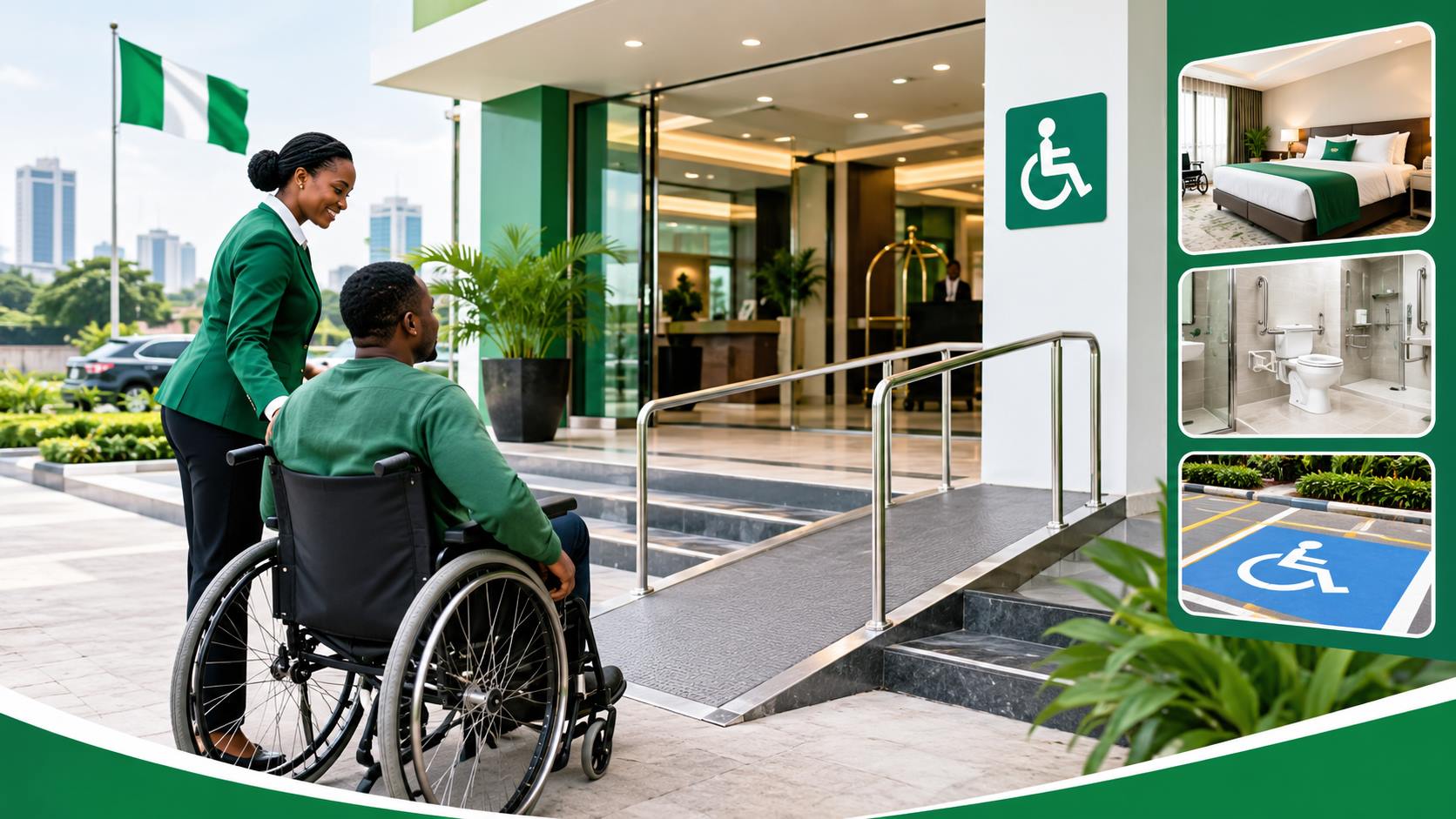
Ask whether the vehicle drop-off area connects to the entrance without steps. If there is a ramp, ask where it is located and whether it is part of the normal entrance route or requires staff to unlock a separate entrance.
A ramp’s existence does not automatically mean it will work for every traveller. Its slope, surface, width, landings and handrails may matter depending on your needs.
Also ask whether the entrance has a raised threshold, loose paving, a narrow doorway or another obstacle.
Reception and corridors
Check whether you can move from the entrance to reception and then to the room without encountering steps or other barriers.
Useful questions include:
- Is the reception area on the same level as the entrance?
- Are there steps between reception and the guest rooms?
- Are corridors wide and clear enough for my mobility aid?
- Are there heavy doors along the route?
- Is the route likely to be obstructed by furniture, luggage or other items?
If the property has several buildings, confirm that the accessible route reaches the particular building where your room is located.
Other facilities
Do not stop checking after reaching the bedroom. If you expect to use the restaurant, breakfast area, meeting room, swimming pool or another facility, ask whether you can reach and use it.
A room may be accessible while the hotel’s restaurant or other important amenities are not.
Practical tip: Ask the hotel to describe the route in order: drop-off point, entrance, reception, lift or ramp, bedroom, bathroom and any essential shared facilities. This often reveals gaps that a general “yes, we are accessible” answer will miss.
4. Confirm Lift Access and Reliability
A lift can make upper-floor accommodation possible for some travellers, but its presence alone is not enough.
Ask:
- Does the property have a passenger lift?
- Which floors does it serve?
- Is the lift available to guests at all times or only during certain hours?
- Is the lift large enough for the traveller and any required mobility aid or companion?
- Is the doorway wide enough?
- Are the controls reachable and easy for the traveller to use?
- What assistance is available if the lift stops working?
These details are particularly important when the room is not on the entrance level.
Consider power interruptions
In Nigeria, some hotels use generators or alternative power sources during electricity interruptions. However, you should not assume that a generator powers every system in the building, including the lift.
Ask the hotel directly whether the lift remains operational during power interruptions and what arrangements are available if it becomes unavailable.
If you cannot use stairs, a room on an upper floor may become unsuitable when the lift is out of service. A promise that staff will help is not necessarily a workable solution, especially if it depends on physically carrying someone.
Ask what the actual procedure is and whether it meets your needs.
Before paying, confirm the room floor and the lift arrangements in writing. If reliable lift access is essential and the hotel cannot explain its backup plan, consider a suitable ground-floor room or another property.
5. Ask About Door Widths and Room Layout
Photographs can show the appearance of a room, but they rarely establish whether a traveller can move through it comfortably.
For a wheelchair user or someone with a mobility aid, door openings, furniture placement and turning space may determine whether the room is usable.
Ask for the clear door-opening width
If you need a particular width, ask the hotel for the clear opening width of the bedroom and bathroom doors. This is the usable space when the door is open, not simply the overall width of the door or frame.
Compare the measurements with your wheelchair, walking aid or other requirements. Do not assume that one universal measurement will work for everyone.
Also ask whether the door can open fully or whether a doorstop, furniture or another obstruction reduces the available space.
Check the bedroom layout
Ask about:
- The space between the bed and the wall.
- The distance between the bed and nearby furniture.
- Whether there is room to turn or manoeuvre.
- Whether the bed height suits your needs.
- Whether the wardrobe, switches, sockets and controls are reachable.
- Whether movable furniture can be rearranged before arrival.
A large room may still be difficult to use if most of its floor space is occupied by furniture.
Request evidence
If the layout is important, request recent photographs or a short video of the actual room being offered. Ask the staff member to show the doorway, the route to the bed, the bathroom entrance and any tight spaces.
A video can be more informative than a carefully framed promotional photograph, although it still may not prove every measurement.
If the hotel cannot provide a reliable measurement, ask whether a staff member can measure the opening before you book.
6. Examine the Bathroom Arrangements
The bathroom deserves special attention because a traveller may reach the bedroom successfully but be unable to use the bathroom independently or safely.
Do not rely only on descriptions such as “modern bathroom,” “spacious bathroom” or “accessible toilet.” Ask what is actually provided.
Bathroom doorway and floor
Confirm the clear opening width of the bathroom door and whether the door opens inward or outward. Ask about raised thresholds, steps and the amount of clear space inside.
Find out whether the floor becomes slippery when wet and whether the shower area has a raised edge.
Shower and bathing arrangements
Ask whether the bathroom has:
- A level-entry or roll-in shower, if required.
- A shower seat or suitable space for a portable seat.
- Grab rails in the positions you need.
- A handheld showerhead, if useful.
- Enough room to enter, turn and transfer safely.
- A bathtub with a high edge, which may not suit your needs.
Do not assume that a grab rail is present because the hotel calls a room accessible. Ask for confirmation and, if necessary, a photograph showing its location.
Toilet and washbasin
Ask whether there is sufficient space beside the toilet for your particular transfer method, if applicable. Check whether the washbasin, taps, mirror and other controls can be reached and used comfortably.
If you need assistance from another person, consider whether there is enough room for both of you.
Water supply and bathroom condition
My hotel stays have also taught me to pay attention to water quality and bathroom condition rather than judging a room solely by its appearance.
For an accessibility-sensitive stay, water availability, drainage, cleanliness and the condition of the shower or bathing area can affect comfort and usability.
Ask whether water is reliably available and whether there is a suitable alternative if the supply is interrupted. If the hotel sends photographs, remember that photographs may not reveal drainage problems, slippery surfaces or other conditions that appear during use.
Important: Ask about the actual bathroom in the room you will receive, not simply the bathroom in a sample photograph.
7. Check Other Accessibility Needs
Accessibility is not limited to wheelchair access.
For travellers with low vision
Ask about lighting along corridors, stairs and bathroom routes. Find out whether staff can provide orientation assistance and whether room numbers and important signs are easy to distinguish.
If you use a particular aid or rely on a familiar room arrangement, explain what would make the space easier to navigate.
For travellers who are deaf or hard of hearing
Ask how staff communicate with guests who cannot hear spoken announcements or telephone calls. If you need visual alerts, written communication or a particular way to receive emergency instructions, confirm whether it is available.
Do not assume that a hotel has visual alarms or specialist communication equipment unless the property confirms it.
For older travellers and people with temporary injuries
A traveller recovering from surgery, wearing a leg brace or using crutches may need a room close to reception, minimal stairs, a handrail or a shower that is easy to enter.
A hotel does not need to label every room as accessible for you to ask whether a specific arrangement is possible. The key is to verify the facilities that matter to your circumstances.
For people with multiple needs
If you have more than one access requirement, check them together. A step-free room with a bathroom that does not meet your needs may not be suitable. Likewise, a well-arranged room may be impractical if you cannot reach it from the entrance.
8. Consider Parking, Transport and the Surrounding Area
Accessibility begins before you enter the hotel.
If you are arriving by car, ask whether there is on-site parking and how far the parking area is from the entrance. Check whether the route is step-free and whether there is enough space to enter or exit the vehicle as required.
If you will use a taxi, ride-hailing service or public transport, consider where the vehicle can stop and whether the final route to reception is practical.
For hotels in busy Nigerian urban areas, the immediate surroundings may include uneven pavements, drainage channels, roadside obstacles, traffic or crowded entrances. Conditions vary by location, so verify the route to the specific property rather than assuming that the neighbourhood will be easy to navigate.
You may wish to ask the hotel to share its location pin and explain the best drop-off point. If you rely on a particular type of vehicle or require assistance with luggage or mobility equipment, confirm that the hotel can accommodate it.
Also check the distance to any essential facility you expect to use, such as a pharmacy, hospital or meeting venue. Do not rely on a hotel’s description of being “close to everything” when the actual route matters.
9. Ask About Staff Assistance and Emergencies
Staff can make a stay easier, but assistance should be discussed clearly and should not replace essential facilities.
Ask whether staff can help with luggage, finding the accessible route, operating a lift or communicating with other departments. Confirm whether the assistance is available at the times you need it.
If you need support during an emergency, ask how guests who cannot use stairs are assisted during a fire, power failure or other evacuation situation.
Useful questions include:
- Is there an emergency evacuation plan for guests who cannot use stairs?
- Which staff members are responsible for providing assistance?
- Is there a safe, designated arrangement for waiting for assistance where applicable?
- How are guests with hearing or visual impairments alerted to emergencies?
- What happens if the lift is unavailable during an emergency?
Do not assume that a standard lift can be used during a fire or that staff can safely carry a guest down stairs. Ask the hotel to explain its actual procedure, then decide whether it meets your needs.
If the answers are unclear and the issue is essential to your safety, seek a more suitable property.
10. GreenLink’s Five-Step Hotel Accessibility Check
At GreenLink, the aim is to help travellers make decisions using practical details rather than relying entirely on promotional descriptions. This five-step process can help you assess a property before making a payment.
Step 1: Describe your needs
Write down the features you must have. Be precise about step-free access, lift use, door widths, room layout, bathroom arrangements, parking or communication support.
Separate essential requirements from preferences. This makes it easier to compare hotels objectively.
Step 2: Ask specific questions
Contact the hotel through its official phone number, email address or booking channel. Ask about each essential feature individually.
Avoid relying on a single question such as “Do you have accessible rooms?” A general answer may not tell you whether the room will work for you.
Step 3: Verify the answers
Where practical, request recent photographs, a video of the route and room, or measurements of the relevant door openings and spaces.
Check that the evidence relates to the actual room type being offered. A photograph of the lobby or a different room is not proof that your assigned room has the same features.
If something remains unclear, ask a follow-up question rather than interpreting silence as confirmation.
Step 4: Confirm the specific room in writing
Before paying, request written confirmation of the room type, floor, lift or step-free route, bathroom facilities and any other essential arrangements.
If a booking agent is involved, ask the agent to confirm the details with the property itself. Keep the response, booking reference and any photographs or messages.
A general hotel description is not the same as confirmation that a particular room will be available on your dates.
Step 5: Recheck before travelling
Facilities can change, rooms can be reassigned and lifts can become unavailable. Contact the hotel shortly before departure to reconfirm the arrangements.
Ask whether the confirmed room is still available and whether any essential access feature is temporarily out of service.
If the hotel reports a change, discuss a suitable alternative before travelling. Do not wait until arrival to discover that an essential arrangement is unavailable.
This process does not certify a hotel as accessible. It helps you collect and verify information relevant to your own needs.
11. Copy-and-Send Hotel Enquiry Message
You can adapt this message and send it to the property before booking.
Subject: Request to Confirm Hotel Accessibility Before Booking
Hello,
I am considering booking a room at your hotel from [arrival date] to [departure date]. Before making a payment, I would like to confirm whether your facilities meet my accessibility requirements.
My main requirements are:
- Step-free access from the drop-off or parking area to reception and the room.
- [Lift access / a suitable ground-floor room / other requirement].
- A bedroom doorway with a clear opening width of [required width, if known].
- A bathroom doorway and layout that meet my needs.
- [Level-entry shower / grab rails / shower seat / other specific bathroom requirement].
- Sufficient space to move around the room and use the facilities I need.
- [Any parking, communication, assistance or emergency arrangements required].
Could you please confirm which of these facilities are available in the actual room you would assign to me?
If possible, please share recent photographs or a short video of the entrance route, bedroom doorway, room layout and bathroom. Please also confirm the room’s floor and whether the lift, if needed, is currently operational.
I would appreciate written confirmation of the essential arrangements before I complete the booking.
Thank you.
Kind regards,
[Your name]
Practical advice: Save the hotel’s response. If staff confirm an essential facility over the phone, ask them to send the confirmation in writing through an official channel.
12. What to Do if a Hotel Cannot Meet Your Needs
Not every hotel will have the same facilities. The important thing is to discover any limitations before committing to a stay.
If a property cannot meet one of your requirements, consider the following steps:
- Ask whether an alternative room is available. A ground-floor room or a different room layout may help, but verify its features rather than assuming it is suitable.
- Explain which requirement is essential. This helps the hotel understand why a general alternative may not work.
- Ask about temporary arrangements. Confirm what they involve and whether they genuinely meet your needs.
- Compare another property. Do not choose a hotel solely because it is cheaper if it cannot provide the facilities you require.
- Check booking terms. Before paying, understand the cancellation, refund and room-change conditions.
- Keep a written record. Save the booking confirmation and any promises about accessibility.
If you arrive and discover that an essential facility is unavailable, contact the manager or booking provider immediately. Explain the difference between what was confirmed and what is actually provided. Ask for a suitable room or another remedy under the applicable booking terms.
If the problem creates an immediate safety risk, prioritise your safety and seek appropriate assistance.
Do not assume that a staff member’s willingness to help automatically makes an unsuitable room safe or usable.
13. Common Hotel Accessibility Mistakes to Avoid
Mistake 1: Trusting the word “accessible”
Ask which specific facilities make the room accessible and whether they meet your individual needs.
Mistake 2: Checking only the bedroom
Verify the complete route, including reception, corridors, lift or ramp, bathroom and any essential shared facilities.
Mistake 3: Assuming a lift always works
Confirm that it serves the required floor, ask about interruptions and establish what happens if it is unavailable.
Mistake 4: Relying on photographs alone
Photographs may hide steps, tight spaces or inconvenient layouts. Request measurements or a video when necessary.
Mistake 5: Assuming all rooms of the same type are identical
Ask whether the room being assigned has the same verified features as the one shown in the photographs.
Mistake 6: Booking before confirming essential details
Verify important arrangements before payment and retain written confirmation.
Mistake 7: Leaving the check until arrival
Contact the hotel before departure to confirm that the room and essential facilities are still available.
Mistake 8: Treating staff assistance as a substitute for access
Help with luggage or opening a door may be useful, but it does not solve every problem involving stairs, narrow doors or an unsuitable bathroom.
14. Hotel Accessibility Checklist Before Booking
Use this checklist when comparing properties.
Arrival and movement
-
I have confirmed the route from the drop-off or parking point to reception.
-
I know whether steps, raised thresholds or other obstacles are present.
-
I have checked the route from reception to the actual room.
-
I have confirmed lift access or a suitable alternative.
-
I have checked access to the facilities I expect to use.
Bedroom
-
I have confirmed the room floor and room type.
-
I have checked the clear doorway width where needed.
-
I have asked about furniture placement and manoeuvring space.
-
I have checked bed height and access to essential controls where relevant.
-
I have received photographs, measurements or other useful evidence where necessary.
Bathroom
-
I have checked the bathroom doorway and entry route.
-
I have confirmed the shower or bathing arrangement.
-
I have asked about grab rails, seating and transfer space if required.
-
I have considered toilet and washbasin access.
-
I have checked water availability and relevant bathroom conditions.
Communication and safety
-
I have confirmed any communication assistance I need.
-
I have asked about emergency and evacuation arrangements.
-
I have confirmed that the staff assistance offered is practical for my needs.
-
I have saved the hotel’s written responses.
Booking
-
The actual room and essential facilities have been confirmed.
-
I understand the cancellation and refund terms.
-
I will reconfirm the arrangements before travelling.
If an essential requirement remains unconfirmed, treat it as an unanswered question—not as a promise that the hotel can meet it.
15. Frequently Asked Questions
1. How can I know whether a hotel in Nigeria is wheelchair accessible?
Contact the hotel and ask about the complete route from arrival to the room, including steps, ramps, lift access, clear doorway widths, room layout and bathroom facilities. Request photographs, measurements or a video where useful, and confirm that the specific room meets your needs before booking.
2. Does a hotel with a lift automatically qualify as accessible?
No. The lift may not serve every floor, may be too small for a particular mobility aid, or may be temporarily unavailable. Check the lift’s location, dimensions where relevant, operating arrangements and the hotel’s plan for interruptions.
3. What does step-free access mean?
Step-free access means a route without steps or raised level changes that the traveller cannot navigate. Depending on the individual, a suitable ramp, lift or level entrance may provide access. Verify the actual route rather than relying on a general description.
4. What door width should I ask a hotel for?
Ask for the clear opening width of the bedroom and bathroom doors, then compare those measurements with your wheelchair, mobility aid or individual requirements. The suitable width depends on the equipment, the person using it and the space needed to manoeuvre.
5. What should I check in an accessible hotel bathroom?
Ask about the doorway, entry threshold, shower or bathtub, grab rails, shower seat, toilet access, washbasin reach and space to manoeuvre or transfer. Confirm which features are actually present in the room you will receive.
6. Should I book a ground-floor room?
A ground-floor room may be useful if it provides the access you need, but its location alone does not guarantee accessibility. Confirm the route from the entrance, the room layout, bathroom arrangements and access to other essential facilities.
7. What if the hotel says it can provide assistance?
Ask what the assistance involves, when staff are available and whether it solves the specific problem. Staff help may be useful for luggage or directions, but it should not be assumed to replace an essential physical access feature.
8. How can I check accessibility if the hotel has no detailed website?
Call or message the hotel through a contact channel you can verify. Ask specific questions, request photographs or measurements and seek written confirmation. If the hotel cannot verify an essential feature, consider another property.
9. Are hotel accessibility claims always accurate?
Descriptions can be incomplete or may refer to some facilities rather than the entire property. Verify the details that matter to you, check the actual room and retain written confirmation. Do not treat a label or photograph as proof that every need will be met.
10. What if the lift stops working after I arrive?
Contact hotel management and ask what safe alternative is available. If you cannot use stairs, do not assume you can manage the route without assistance. If the failure makes the room unsuitable, discuss a practical alternative and consult your booking terms.
11. Can I rely on online reviews to check hotel accessibility?
Reviews can reveal useful experiences, but they may concern a different room, a different date or a different traveller’s needs. Use them as supplementary information and confirm essential features directly with the property.
12. Does this guide certify any Nigerian hotel as accessible?
No. This is a practical guide to help travellers ask better questions and verify facilities. It does not certify any property, confirm compliance with a building standard or establish that a particular hotel meets every accessibility requirement.
16. How This Guide Was Prepared
This guide combines Godwin Samuel’s experience staying in hotels across Nigeria with practical questions travellers can use to verify accommodation details before booking.
Godwin’s firsthand hotel experiences inform the article’s emphasis on room size, bathroom condition, water supply, electricity, parking and other details that affect the actual stay. However, he has not represented those experiences as a professional accessibility audit or claimed to have measured the doorways, tested wheelchair routes or inspected the accessible facilities of specific hotels.
The accessibility checklist is general guidance intended to help travellers confirm their individual requirements directly with accommodation providers. Hotel facilities can change, and the guide does not independently verify the current accessibility of any named property.
GreenLink.com.ng is an independent hotel discovery and travel information platform. It does not own, operate or manage the hotels featured or discussed on the website.
17. Sources and Further Reading
The following authoritative resources provide broader context on disability, accessibility and inclusive participation. They do not certify individual hotels in Nigeria.
- World Health Organization (WHO): Disability and health
Background on disability and barriers that can affect people’s participation in everyday life. - United Nations: Convention on the Rights of Persons with Disabilities
International framework addressing the rights and participation of persons with disabilities, including accessibility.
For a specific hotel or legal question, check the applicable Nigerian requirements and the property’s actual facilities. This article does not make a legal compliance determination.
Final Thoughts
Choosing an accessible hotel in Nigeria requires more than finding a room that looks comfortable or receiving a general assurance from a receptionist. It means checking whether the entire journey—from arrival to the bedroom, bathroom and essential facilities—works for the person who will use it.
My hotel experiences have taught me that the details that matter most are not always the ones shown in promotional photographs. For a traveller with accessibility requirements, those details may determine whether a booking is practical at all.
Start by listing your needs, ask specific questions, verify the answers and obtain written confirmation before paying. Recheck the arrangements before travelling, especially when access to a lift, a particular room or a specific bathroom feature is essential.
A few careful questions before booking can help you avoid an unsuitable room and make a more informed travel decision.
About the Author
Godwin Samuel is a Nigerian traveler, travel publisher and founder of GreenLink.com.ng, an independent hotel discovery and travel information platform. Through GreenLink, he helps travellers discover accommodation options and make more informed decisions about where to stay in Nigeria.
Read more about Godwin Samuel and explore GreenLink’s hotel guides and travel resources.
Leave a Reply