
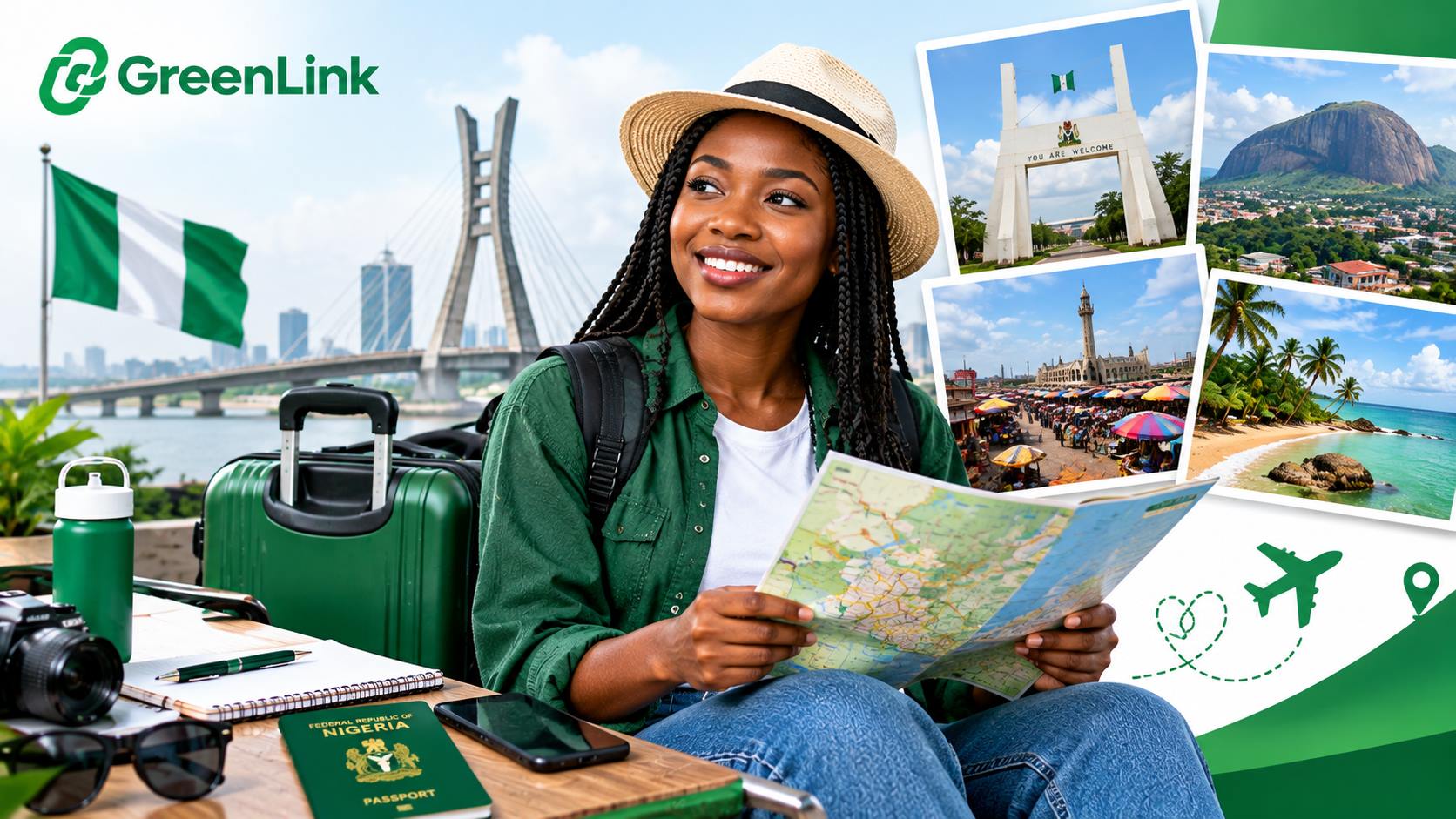
Author: Godwin Samuel
Category: Travel Resources
Published: October 8, 2026
Last Updated: October 8, 2026
If this is your first trip to Nigeria, you may already have many questions.
Where should you go?
How should you get around?
Where should you stay?
How much should you prepare?
What should you know before arriving?
What should you expect from Nigerian hotels?
How do you deal with electricity, water, internet, transportation and payments?
And perhaps the biggest question:
What is travelling around Nigeria actually like?
I cannot answer every one of those questions from a single experience because Nigeria is too large and diverse for that.
READ: How to Check a Hotel’s Location Before Booking: A Practical Guide From My Travel Experience
But I can share what I have learned from travelling around the country myself.
My interest in travel started when I was about 16, when I travelled with my mother. At 18, I began travelling more independently. One of the journeys that shaped how I approach travel was my first major solo trip from Bayelsa State to Imo State by road.
Since then, I have travelled through many parts of Nigeria and stayed in many hotels. The more I travelled, the more I realised that good travel preparation is not about trying to predict everything.
It is about understanding the things that matter, checking what you can, preparing for reasonable problems and remaining flexible when reality is different from your original plan.
That is the approach behind this guide.
I am writing this primarily for people who want practical information they can actually use—not simply a list of places copied from elsewhere.
Key Takeaways
If you are preparing for your first trip to Nigeria, these are the lessons I would want you to remember:
- Nigeria is not one uniform travel destination. Conditions and experiences differ between states, cities, neighbourhoods and communities.
- Research the exact place you are visiting, not only the name of the city.
- Your reason for travelling should determine where you stay.
- Do not choose a hotel based only on photographs or price.
- Check practical hotel details such as water, electricity, Wi-Fi, mobile network, cleanliness, room condition and location.
- Plan your route as carefully as your destination.
- Allow time for unexpected delays.
- Have sensible payment and communication backups.
- Ask questions when you are unsure rather than pretending to know everything.
- Treat current visa, health, transport and security information as information that needs verification.
- Respect local cultures and communities.
- Do not try to see all of Nigeria in one rushed trip.
- Keep your plans flexible enough to enjoy the journey.
- Use firsthand experiences as lessons, not as guarantees of what every traveller will experience.
Table of Contents
- What Is Nigeria Like for a First-Time Traveller?
- How My Own Travel Experience Changed the Way I Prepare
- My First Major Solo Trip From Bayelsa to Imo
- What I Actually Do Before Travelling
- How to Choose Your Nigerian Destination
- Why the Exact Neighbourhood Matters
- How to Choose a Hotel in Nigeria
- What I Check When I Arrive at a Hotel
- Getting Around Nigeria
- Road Travel in Nigeria
- Domestic Flights
- Local Transportation
- Money and Payments
- Mobile Network and Internet
- Electricity and Backup Power
- Water and Food
- Weather and Packing
- Understanding Nigerian Culture
- Communication and Asking for Help
- Health Preparation
- Personal Safety and Current Conditions
- Common Mistakes First-Time Travellers Make
- My Practical Nigeria Travel Framework
- A Sample First-Time Nigeria Trip Planning Process
- How GreenLink Evaluates Travel Information
- What GreenLink Does Not Claim
- Frequently Asked Questions
- Final Thoughts
- About the Author
- Editorial and Verification Note
What Is Nigeria Like for a First-Time Traveller?
The simplest answer is:
Nigeria is diverse.
Your experience can change considerably depending on where you go, why you are travelling, how long you stay, where you sleep and how you move around.
Lagos is not Abuja.
Abuja is not Yenagoa.
Yenagoa is not Port Harcourt.
Port Harcourt is not Owerri.
And even within the same city, one neighbourhood can provide a very different experience from another.
This is one of the first lessons I learned from travelling.
When someone tells me:
“The hotel is in Lagos.”
that is not enough information for me to make a decision.
I want to know the exact location.
What am I going to do there?
How far is the hotel from that place?
How will I get there?
What happens if I need to move around several times?
If I am travelling by road, where will I park?
If I need to work, will the internet and electricity be adequate?
If I am staying for several days, will the room and environment remain comfortable?
Those questions are more useful than simply asking whether a destination or hotel is “good.”
READ: Why Hotel Location Matters When Planning a Trip: Lessons From My Travel Experience
How My Own Travel Experience Changed the Way I Prepare
When I was younger, travelling was mainly about excitement.
I wanted to see somewhere different.
As I travelled more, I started noticing the practical side.
I began asking questions before leaving.
Where exactly am I going?
How long will the journey take?
Where will I sleep?
What happens if I arrive later than expected?
Will I have network?
Can I charge my phone?
How will I pay?
What if the hotel is different from what I expected?
How will I get around after arriving?
Those questions did not come from reading a travel manual.
They developed from actually travelling.
I have experienced journeys where things did not go exactly according to plan. I have dealt with transportation problems, hotel issues and situations where I had to change plans.
Those experiences taught me something important:
Good preparation is not about making travel completely predictable. It is about reducing unnecessary surprises.
My First Major Solo Trip From Bayelsa to Imo
One of the experiences that influenced me most happened when I was 18.
I travelled from Bayelsa State to Imo State by road for a Hero Drink Show.
The journey took roughly four to five hours.
For someone beginning to travel independently, the journey was exciting.
It was also a learning experience.
I noticed the environment changing as I travelled.
I saw different landscapes.
I noticed red soil.
I heard people speaking Igbo.
I experienced differences in food and surroundings.
I met people.
I observed how people interacted.
I stayed in a hotel arranged for the event.
What stayed with me was not simply the fact that I had reached another state.
It was the experience of being responsible for my own movement in an unfamiliar environment.
I had to pay attention.
I had to ask questions.
I had to observe.
I had to make decisions.
That experience helped shape the way I travel today.
When I go somewhere unfamiliar, I do not only think about the destination.
I think about the route.
I think about accommodation.
I think about communication.
I think about food.
I think about money.
I think about what I will do if something changes.
And I try to remain curious about the place itself.
That is the mindset I recommend to a first-time traveller.
What I Actually Do Before Travelling
Over time, I developed a simple preparation process.
I do not necessarily use a formal checklist every time, but these are the things I normally think through.
About a week before the journey
Depending on the trip, I start checking:
1. Destination
I make sure I understand exactly where I am going.
2. Route
I look at how I will get there and where I will start and finish.
3. Accommodation
I confirm where I am staying and how I will reach the property.
4. Contacts
I keep important phone numbers available.
5. Money
I prepare my payment options rather than depending on only one method.
6. Communication
I make sure my phone, SIMs, chargers and power bank are ready.
7. Food
I think about where I am likely to eat, especially if I will arrive late.
8. Time
I avoid creating an itinerary where one delay can ruin the entire day.
9. Backup
I consider what I will do if my original transport, accommodation or communication plan changes.
This process does not eliminate problems.
It simply makes me less dependent on everything going perfectly.
READ: Hotel Parking in Nigeria: What Travelers Should Consider Before Booking
How to Choose Your Nigerian Destination
Start with the reason for your trip.
Ask yourself:
Why am I going?
Your answer could be:
- Business
- Holiday
- Family
- Culture
- Food
- Nature
- Adventure
- An event
- Education
- Research
- Visiting friends
- Exploring Nigeria
The answer should influence the destination.
For example, a person travelling for a business meeting may prioritise convenience and proximity to the meeting location.
A person travelling for relaxation may prioritise environment and leisure facilities.
A person visiting family may care much more about proximity to relatives.
A traveller interested in nature may want an entirely different itinerary.
There is therefore no universal “best Nigerian destination.”
There is only a destination that may be more suitable for a particular traveller and purpose.
Why the Exact Neighbourhood Matters
This is one of the most practical lessons I have learned.
A city name is not a complete location.
Suppose someone tells you:
“I booked a hotel in Abuja.”
That does not tell you enough.
You should still ask:
- Where in Abuja?
- How close is it to your activities?
- What is the exact address?
- How will you get there?
- What landmarks are nearby?
- Is the location convenient for your trip?
The same applies to Lagos, Port Harcourt, Enugu, Ibadan, Benin City, Uyo and other destinations.
My practical rule
Before booking accommodation, save:
Hotel name + full address + phone number + map location + nearby landmark
I have found that having all five is much more useful than saving only the hotel name.
How to Choose a Hotel in Nigeria
I have stayed in many hotels across Nigeria, and one lesson has become increasingly important to me:
Price does not automatically tell you whether a hotel is right for your trip.
A more expensive hotel may offer facilities you do not need.
A cheaper hotel may be convenient but unsuitable for a long stay.
A hotel with beautiful photographs may have practical weaknesses.
So I look at the entire experience.
My hotel decision checklist
Location
Does the location work for my reason for travelling?
Environment
Do I expect the surrounding environment to suit me?
Cleanliness
Does the property appear properly maintained?
Water
Is water availability suitable for my stay?
Electricity
What happens if public electricity is unavailable?
Wi-Fi
Is internet access important for me?
If yes, I want to know whether it is actually usable.
Mobile network
Can I get a reliable enough signal for communication?
Food
Is there food available, and does it fit my needs?
Parking
If I am travelling with a vehicle, where will I park?
Room
Is the room size and layout suitable?
Bathroom
Is it clean and functional?
Air conditioning or fan
Does the room have the cooling arrangement I need?
Staff
Are questions and problems handled responsibly?
Noise
Will the environment allow me to sleep or work?
Payment
How am I paying, and are there conditions I should know beforehand?
Cancellation
What happens if my plans change?
My Hotel Experience: Why I Do Not Judge From Photographs Alone
One of my earliest hotel experiences was at Nickton Hotel in Bayelsa State.
I stayed there for about three days.
I chose the hotel partly because it was close to home and affordable.
There were several things I liked.
The environment was clean and peaceful.
The staff were friendly and caring.
Electricity was good during my stay.
Parking was useful.
There was a visible security presence that made me more comfortable.
The check-in and check-out process was smooth.
But there were also things I did not like.
The water quality was below my expectations.
There was a smell in the bathroom.
The room was not particularly large.
There was no air conditioning in the room I stayed in, so I used a fan.
That experience taught me something I still use when evaluating accommodation:
A hotel does not have to be completely good or completely bad.
It can have strengths and weaknesses at the same time.
More importantly, the thing that is a small weakness for one traveller can be a major problem for another.
For me, water, cleanliness, connectivity, electricity and the general environment matter considerably.
For someone else, a swimming pool may be more important.
That is why GreenLink should not simply tell readers:
“This hotel is good.”
The more useful question is:
“Good for whom, for what type of trip, and based on what evidence?”
My Nickton experience is historical personal experience. I do not use it as evidence of the hotel’s current condition, price, management, facilities or availability.
That distinction is important.
What I Check When I Arrive at a Hotel
My approach has changed over time.
I no longer think:
“I have arrived, so everything must be fine.”
I inspect the room.
Not because I expect every hotel to have a problem, but because finding a problem early is easier than discovering it after several hours or days.
READ: Hotel Wi-Fi and Mobile Network: What Travelers Should Check Before Booking
My basic arrival check
1. Bathroom
I check cleanliness, smell and water.
2. Water
I confirm that the water works and appears suitable for the purpose for which I need it.
3. Bed and room
I look at general cleanliness and room condition.
4. Electricity
I check whether lights and important sockets work.
5. Cooling
If there is an AC or fan, I check whether it works.
6. Wi-Fi
If internet access matters to my trip, I test it.
7. Mobile network
I check whether my phone can connect adequately.
8. Noise
I listen to the environment.
9. General condition
I look at the floor, walls, fittings and obvious maintenance issues.
If something important is wrong, I prefer to raise it early.
That gives the hotel an opportunity to fix the issue.
Getting Around Nigeria
Your transport decision should depend on:
- Distance
- Budget
- Time
- Destination
- Comfort
- Personal preference
- Current transport conditions
Nigeria can be travelled by road or air depending on the journey, while local transportation options vary by city.
The important point is that transportation should be part of your itinerary, not an afterthought.
If you book a hotel because it looks perfect but later discover that it is inconvenient for your daily activities, you may spend much more time and money moving around.
Road Travel in Nigeria
Road travel has been an important part of my experience.
It was how I made my first major solo journey, and I have continued to use roads for many trips.
I enjoy seeing Nigeria from the road.
You notice things that can disappear when you only fly over a place.
You see:
- Communities
- Landscapes
- Markets
- Farms
- Rivers
- Roads
- Buildings
- Food
- Local businesses
- Different ways people live
But road travel also taught me to respect time.
A journey that is expected to take a certain amount of time can take longer.
So I avoid building important plans around extremely tight arrival times.
If I have an important appointment after travelling, I prefer to give myself a reasonable buffer.
My practical rule
Do not plan your arrival as if nothing can delay you.
That does not mean expecting disaster.
It means leaving enough room for ordinary travel uncertainty.
Domestic Flights
For longer journeys, flying may save time.
But your planning should not stop at the airport.
Think about:
- How you will reach the departure airport
- How early you need to arrive
- Baggage requirements
- Arrival airport
- How you will get from the airport to your hotel
- How long that final journey may take
The airport is only one part of the journey.
Your actual journey ends when you reach your accommodation or final destination.
For current schedules, fares and baggage rules, check directly with the airline before travelling.
Local Transportation
If you are unfamiliar with a Nigerian city, do not assume that the transport system will work exactly like the one in another city.
Ask questions.
Your hotel may be able to explain:
- Nearby landmarks
- Common transport options
- Directions
- Approximate travel arrangements
If you are using a map application, save the hotel address and phone number.
A full address can be especially useful when a driver is unfamiliar with the hotel’s name.
Money and Payments in Nigeria
The Nigerian currency is the naira (₦).
My approach to money when travelling is simple:
Do not make one payment method responsible for your entire trip.
Depending on your circumstances, you may use:
- Bank cards
- Electronic transfers
- Cash
- Other appropriate payment methods
Before arriving at a hotel, I prefer to understand:
- The total amount due
- Whether a deposit is required
- Accepted payment methods
- Cancellation conditions
- Additional charges, if any
Keep important payment confirmations.
If a payment is important, having evidence of the transaction can make resolving a misunderstanding easier.
Mobile Network and Internet
Internet access is increasingly part of travel.
For many people, a phone is not just for calls.
It is also used for:
- Navigation
- Banking
- Communication
- Work
- Booking
- Research
- Translation
- Entertainment
I therefore treat connectivity as a practical travel consideration.
Network quality can vary by location.
A network that works well in one place may not perform the same way somewhere else.
Because of this, I have travelled with more than one SIM/network option and more than one phone.
You do not have to copy my exact setup.
The lesson is:
If losing connectivity would seriously disrupt your trip, have a reasonable backup.
READ: Hotel Cleanliness: What to Look for When Choosing Accommodation
Electricity and Backup Power
Electricity is another thing I consider when choosing accommodation.
If I am travelling for work, I care about it even more.
Before booking, you can ask the hotel:
- Is backup power available?
- Are rooms covered?
- How does it work during an outage?
- Does air conditioning work on backup power?
- Can guests charge their devices?
Do not stop at:
“Do you have a generator?”
The better question is:
“What can I actually expect in my room if public electricity is unavailable?”
That answer is more useful.
Water and Food
Water is one of the practical details I pay attention to when staying in hotels.
A hotel can look excellent and still have a water problem that affects your stay.
If water is important to you, ask about availability before booking and check it when you arrive.
Food is different because it is also part of the pleasure of travel.
I enjoy discovering Nigerian food and seeing how food differs between places.
If you have dietary restrictions or allergies, communicate them clearly.
If you are unsure about a food or ingredient, ask.
Weather and What to Pack
Do not pack for “Nigeria” as if the whole country has identical conditions.
Your packing should depend on:
- Destination
- Time of year
- Length of trip
- Activities
- Personal needs
My basic travel items often include:
- Comfortable clothes
- Appropriate footwear
- Phone
- Charger
- Power bank
- Money/payment cards
- Identification
- Necessary medication
- Toiletries
- Appropriate clothing for the destination and activities
For international travellers, check the current weather forecast for your actual destination before departure.
Understanding Nigerian Culture
One of the reasons I enjoy travelling is learning how people live.
Nigeria is culturally diverse.
Different communities have their own:
- Languages
- Food
- Music
- Clothing
- Traditions
- Greetings
- Social customs
- Religious practices
- Historical experiences
You do not need to understand every custom immediately.
You do need to show respect.
If you are unsure whether something is appropriate, ask politely.
For example:
“Is it okay for me to take a photograph?”
That simple question is better than assuming.
The same applies when visiting religious sites, traditional communities, ceremonies or private spaces.
Communication and Asking for Help
One lesson travel has taught me is that asking questions is a strength.
When you are unfamiliar with a place, pretending to know everything can create unnecessary problems.
Ask the right people.
For example:
If you want to know whether a hotel currently has a particular facility, contact the hotel.
If you need to understand a route, ask someone familiar with that area.
If you need current immigration information, use the responsible official authority.
If you need medical advice, speak with an appropriate healthcare professional.
The important part is not simply asking.
It is asking the right person for the right kind of information.
Health Preparation
Health information is one area where I do not recommend relying only on a general travel blog.
If you are travelling internationally to Nigeria, speak with an appropriate healthcare professional before your trip and check current official travel-health information.
Depending on your circumstances and itinerary, health planning may include vaccinations, malaria prevention, food and water precautions, medication and travel insurance.
Current CDC travel guidance for Nigeria, for example, includes recommendations concerning routine vaccinations, malaria and other destination-specific health considerations. It also advises travellers to discuss vaccines and medicines with a doctor before travel. These recommendations can change, so they should be checked before departure.
GreenLink’s role
GreenLink can explain travel-planning considerations.
GreenLink should not replace a doctor, pharmacist or official health authority.
If you have a medical condition, take prescription medication, are pregnant, are travelling with children or have another special health consideration, obtain professional advice appropriate to your circumstances.
Visa and Entry Requirements for International Visitors
If you are visiting Nigeria from another country, do not rely on an old article for immigration requirements.
Visa categories, documentation, application processes and entry procedures can change.
The Nigeria Immigration Service publishes official information about visa categories and tourism visas. Its current tourism-visa information lists requirements including a valid passport, passport photograph, return ticket, accommodation or host information and evidence of funds, while eligibility and requirements can depend on the traveller’s circumstances.
Before travelling:
- Identify your nationality and travel status.
- Determine the appropriate visa or exemption category.
- Check the current Nigeria Immigration Service requirements.
- Use the appropriate official application channel.
- Keep copies of important documents.
- Check the requirements again before departure.
Do not treat this article as your immigration application guide.
Use GreenLink to understand what to investigate, then confirm the actual requirement through the responsible authority.
Personal Safety and Current Conditions
This is another area where honesty matters.
I have travelled around Nigeria, but my personal experience on a particular journey does not prove that a location is currently safe.
Conditions change.
A place I visited previously may have different circumstances today.
Therefore, before travelling, check current information from appropriate sources, including:
- Relevant Nigerian authorities
- Your accommodation
- Trusted local contacts
- Your embassy or consulate where applicable
- Current official travel advisories
If there is a developing security issue, major disruption, severe weather event or other urgent situation, use current information rather than relying on an old GreenLink article.
What I do not want GreenLink to do
I do not want GreenLink to pretend to be a live security monitoring service.
A travel guide can provide planning information.
It cannot guarantee what will happen tomorrow.
Common Mistakes First-Time Travellers Make
1. Choosing a hotel from photographs alone
Photographs are useful, but they do not tell you everything.
Check location, current information, room details and recent feedback.
2. Choosing the cheapest accommodation without calculating the total trip cost
A cheap hotel far from everything you need may create higher transport costs and more inconvenience.
Look at the entire trip.
3. Assuming the city name tells you enough
It does not.
Find the exact neighbourhood and address.
4. Leaving accommodation until arrival
For a first trip, arranging your important accommodation beforehand can reduce stress.
5. Depending on one payment method
Have a sensible backup.
6. Depending on one phone network
If communication is essential, consider a backup option.
7. Forgetting the hotel address
Save the full address, phone number and map location.
8. Assuming old information is still current
Hotels change.
Transport changes.
Policies change.
Visa requirements change.
Health information changes.
Security conditions change.
Verify time-sensitive information.
9. Trying to visit too many places
A rushed trip can become a transportation exercise instead of a travel experience.
10. Treating every local experience as a universal Nigerian rule
One person’s experience in one city is not necessarily a national rule.
This is especially important when writing or reading travel content.
My Practical Nigeria Travel Framework
After years of travelling, I think about a trip using five stages:
1. DEFINE
What am I travelling for?
2. PLAN
Where am I going?
How will I get there?
Where will I stay?
3. VERIFY
Which details could seriously affect my trip?
I verify those.
4. PREPARE
What do I need?
What backups are reasonable?
5. EXPERIENCE
Once the important preparation is done, I pay attention to the destination.
This final stage matters.
Travel should not become so over-planned that you stop experiencing the place.
A Sample First-Time Nigeria Trip Planning Process
Imagine someone is visiting Nigeria for the first time for seven days.
Here is how I would approach the planning.
Step 1: Decide the purpose
Suppose the person wants a mixture of business and leisure.
Step 2: Choose one primary city
Rather than trying to visit six states in seven days, choose a practical base.
Step 3: Plan the arrival
Determine:
- Airport or road arrival
- Transport to accommodation
- Approximate arrival time
- Contact person
Step 4: Choose accommodation based on the itinerary
The hotel should be convenient for the actual activities.
READ: Questions to Ask a Hotel Before Making a Reservation
Step 5: Verify important hotel details
Check:
- Room
- Water
- Electricity
- Wi-Fi
- Payment
- Cancellation
- Location
Step 6: Build a simple daily plan
Do not schedule every minute.
Leave room for travel time.
Step 7: Prepare backups
Keep alternative payment and communication options.
Step 8: Verify time-sensitive information
Before departure, check current:
- Entry requirements
- Health guidance
- Transport information
- Weather
- Local conditions
Step 9: Travel
Now enjoy the experience.
That is how I prefer to approach travel.
How My Hotel Experiences Influence GreenLink
My hotel experiences are one of the main reasons GreenLink exists.
I have stayed in hotels where I was comfortable.
I have stayed in hotels where certain things disappointed me.
I have changed rooms.
I have complained about problems.
I have had situations where a refund was not available and another room was offered instead.
Those experiences taught me that hotel reviews should not simply be:
“I liked it.”
or:
“I did not like it.”
The useful question is:
What happened, and what should another traveller learn from it?
For example:
If the Wi-Fi worked well, I want to explain why that mattered.
If the water disappointed me, I want to explain how it affected the stay.
If staff responded quickly to a problem, that is useful information.
If a hotel was peaceful, I want to explain what I mean by that rather than simply calling it “the best hotel.”
This is the type of practical information I want GreenLink to develop.
Why I Created GreenLink
The idea behind GreenLink did not come from simply wanting to create another travel website.
One experience that influenced the idea happened after I stayed at a hotel and recommended it to a friend.
My friend tried to find the hotel but missed it.
He eventually booked another hotel on the same street.
That experience made me think about the problem differently.
A traveller may know the city.
They may even know the hotel name.
But finding accommodation that actually matches their needs can still be difficult.
That is part of the problem GreenLink is designed to help solve.
GreenLink’s purpose is:
Connecting Nigerian travellers with hotels that match what they are looking for.
The platform is independent.
GreenLink does not own or operate the hotels featured on the platform.
The goal is to help travellers discover and compare accommodation based on practical needs, preferences and budget.
How GreenLink Evaluates Travel Information
This is an important part of our approach.
Not every statement on a travel website has the same level of evidence.
I therefore think about information in categories.
1. First-hand experience
Something I personally experienced during a trip or hotel stay.
Example:
“During my stay, the room had no air conditioning.”
That describes my experience.
It does not automatically describe the hotel today.
2. Current verified information
Information checked against an appropriate current source.
Examples can include:
- Current official requirements
- Current hotel information
- Current transport information
Time-sensitive facts should be rechecked.
3. Hotel-provided information
Information supplied directly by a hotel.
This should not automatically be treated as an independent review.
4. Traveller-reported information
Information reported by another traveller.
It can be useful, but one person’s experience should not automatically be presented as universal fact.
5. General practical guidance
Advice based on travel experience and reasonable planning principles.
6. Information requiring verification
Some facts should always be checked before acting on them.
These include:
- Prices
- Availability
- Visa requirements
- Transport schedules
- Hotel policies
- Opening hours
- Current security conditions
- Health requirements
- Temporary closures
- Current facilities
This distinction is central to trustworthy travel publishing.
What GreenLink Does Not Claim
GreenLink will not claim:
- That an old hotel experience proves current conditions
- That one traveller’s experience represents every traveller
- That the cheapest hotel is always best
- That the most expensive hotel is always best
- That photographs prove current room conditions
- That a hotel is permanently safe because someone stayed there previously
- That a destination is universally “the best”
- That every facility advertised online currently works
- That a hotel is currently available without checking
- That a current price is valid indefinitely
- That a travel route will always take a specific amount of time
We also should not create fake experiences, fake reviews, fake photographs, fake credentials or artificial claims of expertise.
If I have not personally experienced something, I should not write as if I have.
If something is uncertain, I would rather say that it needs verification.
What Makes My Approach Different?
I do not want GreenLink to become a website where every article follows the same generic formula:
Introduction → 10 tips → conclusion.
Travel is more useful when readers understand how decisions are actually made.
For example:
Instead of:
“Choose a hotel with good Wi-Fi.”
I would rather explain:
“When I am travelling for work, Wi-Fi becomes part of my accommodation decision. I do not simply look for the word ‘Wi-Fi’ in a listing. I want to know whether it is available where I will be staying and whether I can actually use it for what I need.”
That is the difference between listing a feature and explaining its practical importance.
How I Use AI and Other Tools
GreenLink may use digital tools, including AI-assisted tools, for tasks such as:
- Organising information
- Improving drafts
- Identifying missing questions
- Structuring content
- Checking consistency
- Supporting research
But tools should not replace firsthand experience.
If an article is based on my personal hotel stay, the experience should come from what I actually experienced.
AI should not invent a hotel stay.
It should not invent a conversation with hotel staff.
It should not invent a destination visit.
It should not create false evidence.
Human editorial review remains important.
The reason for using such tools is to improve the usefulness and organisation of the content—not to manufacture expertise or mass-produce pages simply for search traffic.
Original Photos and Evidence
Where practical, GreenLink should use original photographs from actual journeys and hotel visits.
For example:
- A photograph taken during a road trip
- A photograph of a destination I personally visited
- A hotel photograph taken during a stay
- A photograph showing a relevant travel experience
Where photographs are used, they should be accurately captioned.
A photograph from 2018 should not be presented as if it shows the hotel’s condition in 2026.
If an old photograph is used to illustrate a historical personal experience, the caption should make that clear.
This is part of being honest about the evidence behind travel content.
How to Use This Guide
You do not need to follow every recommendation.
Use the sections that apply to your trip.
If you are a Nigerian travelling from one state to another, you may not need the visa section.
If you are visiting Nigeria from another country, the visa and health sections become more important.
If you are travelling for business, connectivity, location and electricity may be high priorities.
If you are travelling with family, room size, food, water and the environment may matter more.
If you are travelling by road, parking and route planning may become more important.
The goal is not to give every traveller the same checklist.
The goal is to help you build the checklist that matches your trip.
READ: How to Read Hotel Reviews Without Relying on Them Alone
Practical Nigeria Travel Checklist
Before booking
- Define the purpose of your trip
- Choose your destination
- Research the exact area
- Compare transport options
- Compare accommodation
- Check the hotel’s exact location
- Check recent information
- Confirm important hotel facilities
- Check payment arrangements
- Check cancellation conditions
Before departure
- Confirm accommodation
- Confirm transportation
- Save the full address
- Save important phone numbers
- Check current weather
- Check current entry requirements if travelling internationally
- Check current health guidance
- Check current travel conditions
- Prepare payment options
- Charge your devices
- Carry a power bank
- Prepare necessary medication
- Keep important documents accessible
When you arrive
- Confirm the location
- Check your hotel room
- Check the bathroom
- Check water
- Check electricity
- Test Wi-Fi if important
- Check mobile network
- Check AC/fan
- Check cleanliness
- Ask questions about anything unclear
During the trip
- Keep important contacts accessible
- Monitor changing conditions
- Keep your plans flexible
- Respect local customs
- Keep important payment information
- Document useful experiences
- Enjoy the destination
Frequently Asked Questions
Is Nigeria good for first-time travellers?
Nigeria can provide a wide range of travel experiences, but first-time visitors should research their specific destination and prepare appropriately. Nigeria is diverse, so conditions and experiences can differ significantly between locations.
What should I know before travelling to Nigeria?
Start with your destination, purpose, transportation, accommodation, payment options, communication, health preparation and any current entry requirements that apply to you.
What is the best place to visit in Nigeria for a first-time traveller?
There is no single destination that is best for everyone. Your choice should depend on your interests, budget, available time and reason for travelling.
Should I book my hotel before travelling?
For a first trip, arranging important accommodation beforehand can reduce unnecessary stress, particularly if you have a fixed itinerary or arrival time.
How should I choose a hotel in Nigeria?
Start with location and purpose. Then consider cleanliness, water, electricity, Wi-Fi, mobile network, room condition, food, parking where relevant, staff responsiveness, price and cancellation conditions.
Should I trust hotel photographs?
Photographs are useful but should not be your only source of information. Check current information, room details, location and recent traveller feedback where available.
What should I check when I arrive at my hotel?
Check the room, bathroom, water, electricity, cooling, Wi-Fi if important, mobile network and general cleanliness. If something important is wrong, raise it with the hotel early.
Can I travel around Nigeria by road?
Yes, road travel is an important way of moving around Nigeria, but your route, distance, schedule and current conditions should be considered before travelling.
Should I travel around Nigeria by air?
Flying can be useful for longer journeys where saving time is important. Consider the entire journey, including getting to the airport and travelling from the arrival airport to your accommodation.
What currency is used in Nigeria?
Nigeria uses the naira, represented by ₦.
Should I carry cash in Nigeria?
It can be useful to have some local currency available, while also maintaining another suitable payment option. Avoid making your entire trip dependent on one payment method.
Will my phone work in Nigeria?
This depends on your mobile provider, device, SIM and location. If connectivity is important, check your arrangements before travelling and consider having a backup.
Is Wi-Fi available in Nigerian hotels?
Many hotels advertise Wi-Fi, but quality and availability can vary. If internet access is important to your trip, confirm the current arrangement with the hotel.
What about electricity in Nigerian hotels?
Electricity arrangements vary between hotels. If uninterrupted power matters to you, ask specifically about backup power and whether guest rooms are covered.
Do international visitors need a visa for Nigeria?
Requirements depend on nationality, travel purpose and applicable exemptions or visa categories. International visitors should check current information directly with the Nigeria Immigration Service or the relevant Nigerian diplomatic mission before travelling.
What health preparation should I make?
International travellers should check current travel-health guidance and speak with an appropriate healthcare professional about vaccines, malaria prevention, medication and other destination-specific considerations.
How can I stay safe while travelling in Nigeria?
Research your specific destination, monitor current conditions, use sensible precautions and follow relevant official advice. Do not rely on an old personal travel experience as proof of current conditions.
Is Nigeria the same everywhere?
No. Nigeria contains many different communities, environments, cultures and travel experiences.
How long should I spend travelling around Nigeria?
There is no universal answer. It is usually better to create a realistic itinerary that gives you enough time to experience your chosen destinations rather than trying to visit too many places in a short period.
What is the biggest mistake first-time travellers make?
One common mistake is assuming that everything will work exactly as planned. A better approach is to prepare for the important things while keeping enough flexibility to adapt.
Final Thoughts: Prepare for the Journey, Not Just the Destination
My first major solo journey from Bayelsa to Imo was more than a trip between two states.
It changed the way I think about travelling.
I learned that travelling means paying attention.
Pay attention to the road.
Pay attention to people.
Pay attention to the environment.
Pay attention to the hotel.
Ask questions.
Observe.
Learn.
And prepare.
But I also learned not to expect travel to be perfectly predictable.
Sometimes a hotel will not be exactly what you expected.
Sometimes a journey will take longer.
Sometimes your original plan will change.
Sometimes you will discover something better than what you originally planned.
That is part of travel.
Nigeria is a country I still want to explore more deeply.
I have travelled through many parts of it, but I do not believe that travelling to a number of states means I have “finished” Nigeria.
There is always another community to discover.
Another road to travel.
Another food to try.
Another story to hear.
Another place to understand.
That curiosity is one of the reasons I created GreenLink.
I want GreenLink to help people make better travel and accommodation decisions while also encouraging them to experience Nigeria for themselves.
I do not want GreenLink to tell you that every hotel is perfect.
I do not want it to pretend that every destination is identical.
I do not want it to manufacture experiences that never happened.
And I do not want old information presented as if it is current.
I want the platform to help answer practical questions:
Where can I stay?
Does the location make sense for my trip?
What should I check before booking?
What should I verify?
What should I prepare?
What should I do when something does not go according to plan?
Those questions are at the heart of practical travel.
So if this is your first trip to Nigeria, my advice is simple:
Prepare intelligently.
Verify important information.
Choose accommodation based on your actual needs.
Have reasonable backups.
Respect the people and places you encounter.
And most importantly:
Stay curious.
Nigeria is more than a destination on a map.
You understand it better when you take the time to experience it.
About the Author
Godwin Samuel
Godwin Samuel is a Nigerian traveller, travel publisher and founder of GreenLink.com.ng.
His interest in travel began at about 16 when he travelled with his mother. At 18, he began travelling more independently, including his first major solo road journey from Bayelsa State to Imo State.
Since then, he has travelled through many Nigerian states and stayed in numerous hotels. His travel experience has developed into a practical interest in accommodation, transportation, destination discovery, local experiences and the small details that can make a major difference to a traveller’s trip.
READ: Hotel Photos vs Reality: What Travelers Should Check Before Booking
Godwin began blogging in 2016 and later created GreenLink as a Nigeria-focused hotel discovery and travel information platform.
His approach is based on firsthand experience where available, careful distinction between personal experience and current information, practical observation and a willingness to identify uncertainty rather than invent an answer.
GreenLink’s purpose is to help connect Nigerian travellers and visitors with accommodation and travel information that matches their needs, preferences and budget.
GreenLink does not own or operate the hotels featured on the platform.
GreenLink’s Editorial and Information Policy for This Guide
This guide combines several types of information.
First-hand experience
Personal experiences are written from trips and hotel stays that the author actually experienced.
Current official information
Where a matter can change—such as immigration or health requirements—GreenLink directs readers toward appropriate current sources rather than presenting an old article as permanently authoritative.
Practical travel knowledge
Some recommendations come from repeated travel experience and are presented as practical guidance rather than universal rules.
Hotel information
Where a hotel provides information about its facilities, policies or services, that information should be treated as hotel-provided information unless independently verified.
Traveller feedback
Traveller reviews can provide useful clues but represent individual experiences and may not describe every traveller’s experience.
How This Article Should Be Maintained
This is an evergreen guide, but not every part of it is permanently current.
GreenLink should periodically review sections concerning:
- Immigration requirements
- Health guidance
- Transportation
- Airport procedures
- Hotel booking practices
- Payment systems
- Travel disruptions
- Major changes affecting travellers
The Last Updated date should only change when the article has actually been meaningfully reviewed or updated.
GreenLink should not change the date merely to make the article appear fresh.
If a major current issue affects travellers, the relevant section should be updated with the new information and the update should be explained where appropriate.
READ: What to Do When Your Hotel Experience Is Different From What You Expected
Editorial Boundaries
This guide is intended for travel planning and education.
It is not:
- Immigration advice
- Medical advice
- Legal advice
- A live security-monitoring service
- A guarantee of hotel conditions
- A guarantee of transport duration
- A guarantee of prices or availability
For matters involving health, immigration, law or rapidly changing safety conditions, readers should consult the appropriate current authority or qualified professional.
Leave a Reply